

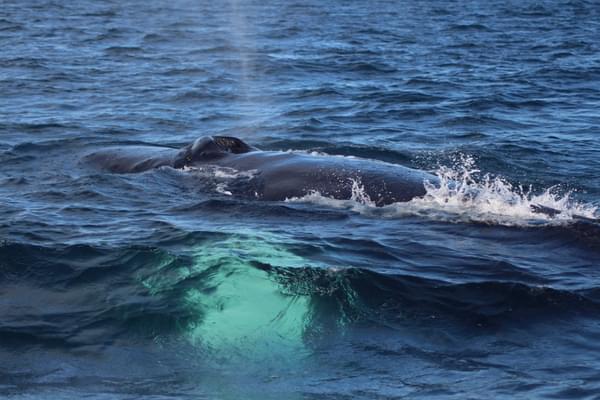
A humpback surfaces ahead of Cunard’s Queen Elizabeth. From the bridge, an ORCA observer can see where the whale has come up for air and, with luck, which way it is travelling. Then the whale dives. The officer on watch has a decision to make, and a ship nearly 300 metres long in which to make it.
For five years, ORCA’s Marine Mammal Observers have worked alongside the bridge team on Queen Elizabeth in Alaska. As the ship’s final Alaska season draws to a close, one figure gives a sense of just how much our observers and the crew have contributed. Between May and September 2026, Queen Elizabeth reported 1,424 whale sightings to Whale Alert Alaska, more than any other vessel and over a third of the 4,021 sightings submitted by the entire network.
Those reports give other mariners advance warning of whales along their route. Aboard Queen Elizabeth itself, the conversation is more immediate. How far ahead is the whale? Is it swimming across the bow? Is there a calf alongside it? Our observers relay what they can see directly to the officer on watch. They also train crew members to recognise the signs of whales at sea and record how both ship and whale respond when their paths bring them close together.
It is those records that have helped us answer a surprisingly difficult question. When someone on the bridge spots a whale, how much room does a ship of this size actually have to get out of its way?
In a paper presented to the International Whaling Commission’s Scientific Committee in 2024, researchers from ORCA and the International Fund for Animal Welfare examined 24 encounters with humpbacks over eight voyages between Vancouver and Alaska. The bridge team altered course in every case and also reduced speed on four occasions. Using the ship’s GPS track, the researchers could see how closely she passed the spot where the whale had first surfaced, and compare that with the route she would otherwise have taken.
An early sighting could give the crew room to steer clear. But when a humpback was first seen less than 1,000 metres ahead, just over half a mile, changing course alone produced no overall gain in clearance at the speeds studied. And a whale can swim some distance while a ship is turning. One of the clearest findings was the value of slowing down before entering waters where whales are likely to be. By the time someone spots a blow, much of that room for manoeuvre may already have gone.
As our five years aboard Cunard’s Queen Elizabeth in Alaska comes to an end, we owe a thank you to the observers who kept watch and the officers and crew who worked alongside them. Together they have given other mariners something to draw on when a humpback surfaces ahead of their own ship.
Help protect whales and dolphins
Your donation funds vital research, conservation projects, and citizen science efforts around the world. Every pound makes a difference.