
Since 2007, teams of dedicated volunteer ORCA Marine Mammal Surveyors have been invited on board Saga cruise ships to provide guests with incredible wildlife experiences through delivering presentations, running deck-watches, and generally being on hand to talk about any wildlife seen on the trips. ORCA Marine Mammal Surveyors collect vital data on the whales and dolphins they see during these trips, whilst also being out on deck to help guests to spot and identify the marine life they are seeing for themselves.
In November, Jan, Becky, Stuart and John boarded the Spirit of Discovery for what proved to be an exceptional four weeks sailing to the tropical West Caribbean. Wildlife Guide and Trainee Team Leader, Stuart, shares the team’s experience:
The team’s first full sea day happened to be Halloween, a time of ‘trick or treat’ and things that go ‘bump’ in the night. As it transpired the only thing bumping in the night was the ship, as we headed into the predicted heavy weather heading southwest across the Bay of Biscay. The open decks were out of bounds for the first part of our voyage, and we were also informed that the Azores stopover was now not possible due the Atlantic storm – Vigo in Spain was to be our first stop.
The team set themselves up by the windows in the Britannia lounge, ever hopeful for sightings and an opportunity to engage with guests. We knew we were traversing an Important Marine Mammal Area (IMMA) and despite the challenging sea conditions we were rewarded by sightings of 14 common dolphins (including a calf). We also completed our first bridge survey of the trip and after watching for six hours, we recorded 34 striped dolphins with a calf.

Upon leaving Vigo after a day in port, we had enough daylight hours and more settled conditions to allow for a deck watch with guests. It was a productive session with a total of 27 dolphins recorded approaching the ship, as well as our first whale encounter with two minke whales sighted.
We now had seven sea days ahead of us crossing the Atlantic to Barbados and a chance to settle into a routine of deck watches and scientific surveys from the bridge. Being on the bridge allowed us to use ORCA’s Distance Sampling Survey Protocol for ‘gold standard’ data collection whilst one team member remained on deck 14 to engage with guests. Entering tropical waters, with trade winds establishing themselves from astern, temperatures increased on deck and everyone began to notice flying fish in their hundreds covering surprising distances as they scattered through the ship’s wake. We recorded a distant whale blow which signalled the presence of larger pelagic species as the ship approached the mid-Atlantic ridge.
Over the next few days we encountered pan-tropical spotted dolphins and a pod of possible Clymene dolphins. We were joined by brown and masked boobys which were to be our constant companions from now on in tropical waters.
After our first few port stops in the Caribbean islands, we had a sea day leaving Curacao, where we recorded more pan-tropical spotted dolphins as well as a resting pod of 24 false killer whales. Three more island visits followed, including a tendered visit to St Barthelemy where turtles and a dolphin were seen from the tenders as they shuttled back and forth to the ship. Impressive spotted eagle rays were also photographed from the ship by a guest as we approached Antigua – our final Caribbean island destination.
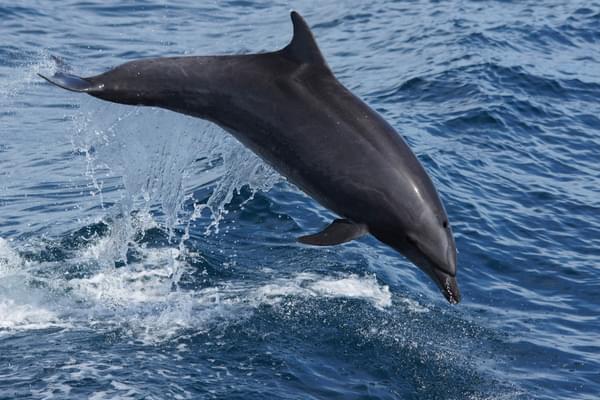
We now had seven sea days as we headed back across the Atlantic and re-encountered the mid-Atlantic ridge on our journey to the Azores. The weather and sea conditions felt more settled at last, and we were hopeful for some good sightings. We were not disappointed with this week at sea; it wasn’t long before we recorded a breaching humpback whale, followed by several Atlantic spotted dolphin encounters. During an eventful day as we neared the Azores, we recorded a distant whale blow, two sei whales, a possible minke whale, 12 false killer whales, and several dolphin pods – one of which seemed to be a mixed pod. On examining our photos we could indeed see two rough-toothed dolphins swimming with 12 Atlantic spotted dolphins – we had noticed their size and behaviour difference in the water and the photo confirmed this.

The team spent a day in Ponta Delgada where we were able to catch up with some of our data admin. Whilst docked in port we spotted a local boat trip enjoying an encounter with common dolphins close to the harbour, and as we departed several whale blows and pods of dolphins were recorded as the sun set. For the final part of the trip back to Portsmouth, conditions mirrored our departure at Halloween; things began to go ‘bump’ in the night again as we weathered another spell of heavy weather and a high sea state. Nevertheless, a successful Wildlife Clinic and well attended round-up presentation allowed us to review and reminisce on a great trip!
Our thanks must go to the entire Spirit of Discovery crew, and especially Captain Luko, Chief Officer Eddie, Cruise Director Paul, and Assistant Cruise Director Meg for being so welcoming and helpful throughout the entire trip. Many thanks also to ORCA itself and the hardworking office team who make all this vital data collection work possible.
ORCA's vital conservation work is made possible by our incredible network of volunteer Marine Mammal Surveyors and OceanWatchers. Why not train to become an ORCA volunteer yourself?