Norway has announced a commercial whaling quota of 1,641 common minke whales for 2026, an increase of 235 on last year. The government says the rise is largely administrative: unused quota from previous years has been carried over. In 2025, 10 vessels took part in the hunt and 429 whales were killed - well below the quota that was available.
The Minister of Fisheries and Oceans, Marianne Sivertsen Næss, framed the decision as modern, responsible “ocean management” - claiming Norwegian whaling is “sustainable” and “strictly regulated”, that it uses “animal welfare-friendly” methods, and even arguing that whales’ fish consumption affects ecosystems so whaling “contributes to balance in the ocean”.
This is a curiously similar to messaging being spun out recently by the Japanese whaling industry, who claim that whaling is “ecosystem management”, arguing that idea whales must be “culled” to keep seas “balanced”. Norway and Japan must be sharing the same PR agency.
The Norwegian Minister also linked whaling to the UN sustainability goals, suggesting we must “eat more seafood” and that whaling provides “healthy and local food.”
This messaging matters because it tries to repackage a controversial practice, somewhat unconvincingly, as climate- and nature-positive. But “sustainable” isn’t just a question of population modelling and paperwork. It also includes welfare, ethics, and the wider ecological role of whales.
A brief history: why Norway is still whaling at all
Commercial whaling is subject to the International Whaling Commission (IWC) moratorium, yet Norway continues by operating under its own domestic framework and setting its own catch limits (while reporting catches and data to the IWC). This long-running position has kept Norway aligned with commercial whaling long after most countries moved on, and long after whales became globally recognised as wildlife worth protecting alive, not commodifying.
“Welfare-friendly”? The evidence is more complicated
Norway often points to the use of explosive harpoons and training as proof of humane practice. But data reviewed through the North Atlantic Marine Mammal Commission’s (NAMMCO - an intergovernmental body made up of Norway, Iceland, Greenland (via Denmark), and the Faroe Islands) expert process shows that even where many deaths are recorded as “instantaneous,” a significant minority are not: in one dataset 82% were recorded as instant deaths, while among the remainder the median time to death was 6 minutes, and one whale took 20–25 minutes after being wounded and re-shot.
NAMMCO’s own technical guidance describes the “Whale Grenade-99” system used in hunts, including an explosive charge of pressed penthrite designed to detonate inside the whale. 5+ minute deaths for a large, conscious, air-breathing mammal can never be positioned as “welfare-friendly” with any degree of credibility.
A quota that keeps rising - while the hunt doesn’t
The government’s own figures show the industry is small and the quota is rarely approached in practice (429 whales taken in 2025 against a much larger available limit). That gap raises an obvious question: if whaling is truly the essential “local, healthy food system” being advertised, why is no-one (quite literally it would seem) buying it? It seems to stubbornly persist largely as a political symbol, from which any logic is missing - while Norway’s international reputation takes the hit.
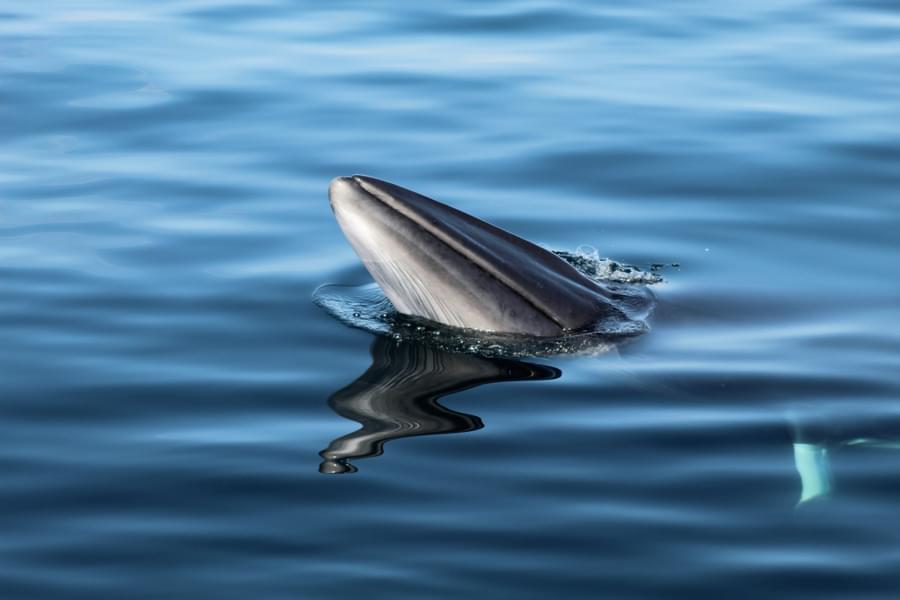
Main photo: Minke whale (credit Hannah Snead)
ORCA’s work is global, and your support drives real change. From thousands of sightings to creating safe ocean spaces, every volunteer, every donation, and every sighting makes a difference.