

In South Georgia’s waters, an Antarctic blue whale has been successfully matched across years for the first time - a rare, scientifically powerful “re-sighting” made possible by photo-identification and data sharing through HappyWhale, with a big assist from citizen scientists.
The individual - now nicknamed Magrathea (a salute to Douglas Adams’ Hitchhiker’s Guide to the Galaxy) - was first photographed in 2019, and then re-sighted in 2026 during an ORCA survey aboard HX’s Fram.
Antarctic blue whales are still among the most threatened whale populations on Earth - the Antarctic subspecies is classed as Critically Endangered, and the International Whaling Commission notes estimates remain below 1% of pre-whaling size. So when you can confirm the same individual is returning to the same region across years, that’s not just a nice story - it’s a datapoint with real conservation weight.
This match directly strengthens the Sustained Monitoring of Whales at South Georgia project (led by British Antarctic Survey (BAS) with multiple partners, including ORCA, IAATO, HappyWhale and the Government of South Georgia and the South Sandwich Islands).
And it hints at something especially exciting: possible regional fidelity - the idea that at least some Antarctic blue whales may be using South Georgia as a repeat destination, not merely passing through as “one-off” circumpolar visitors. It’s an early signal, not a final conclusion - but it’s exactly the kind of clue long-term monitoring is built to detect.

South Georgia: from whaling epicentre to recovery hotspot
South Georgia was hit brutally hard by industrial whaling. Between 1904 and 1971, records indicate 42,698 blue whales were killed there and for decades afterwards, blue whales were almost absent from dedicated surveys (with only one sighting between 1998 and 2018).
The last few years have brought more hopeful signs. A February 2020 survey alone logged 58 blue whale sightings, alongside acoustic detections - evidence that blue whales are returning to forage in these waters.
Today, South Georgia is thought to host extraordinary whale density in summer - with BAS estimating 30,000+ whales visiting in the season, the majority being humpbacks, while Antarctic blue whales and southern right whales remain far from full recovery.
ORCA’s role: turning expedition travel into repeatable science
Magrathea’s 2026 re-sighting came during ORCA’s Southern Ocean Distance Sampling Project aboard HX Expeditions MS Fram - part of a Darwin Plus-backed effort to build a sustainable monitoring framework around South Georgia and help guide protections as vessel traffic increases.
ORCA’s survey work in the region has already been substantial: in the 2024/25 Antarctic season, ORCA researchers surveyed 189 hours 40 minutes, covering 4,122 km, recording 998 sightings of 2,322 individual animals across 12 cetacean species - the kind of consistent effort that makes rare discoveries like this far more likely.
The bigger protection picture: a safer ocean for giants
South Georgia and the South Sandwich Islands has one of the world’s largest MPAs (about 1.24 million km²), and the territory continues to strengthen marine protection measures - including restrictions and closures designed to reduce pressure on key wildlife and habitats.
At the same time, the BAS monitoring programme is explicitly focused on understanding whale occurrence alongside shipping, underwater noise and environmental change, and on developing risk-reduction protocols (including around speed and noise) to improve conditions in important whale habitats.
A quick word on HappyWhale (and why it’s so effective)
HappyWhale is one of the best examples of citizen science “punching above its weight”. In simple terms: people upload whale photos with sighting details, and researchers (increasingly supported by image-recognition tools for some species) can match individuals across time and space - building life histories and migration maps that would be impossible for any one team to collect alone.
What makes it especially powerful is the feedback loop: contributors can be notified when a whale they photographed is identified - and even when it’s seen again later.
In Magrathea’s case, that shared photo-ID infrastructure is exactly what allowed a once-in-a-blue-moon match to become a confirmed, usable scientific record - and a moment of genuine hope for a whale still climbing back from the brink.
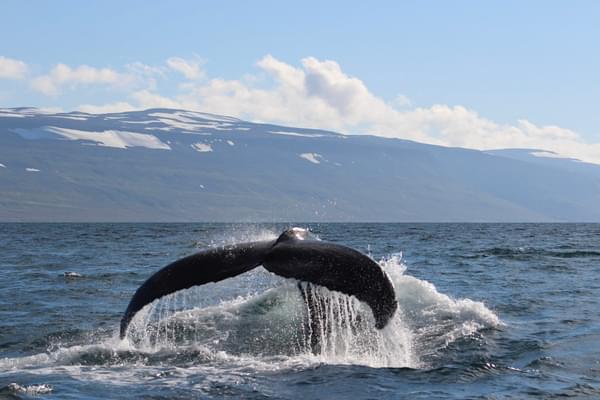
Main image: Antarctic blue whale Magrathea (credit Taryn Lawson/HX Expeditions)
We are ORCA, one of the leading whale and dolphin charities globally. Through volunteering, citizen science, and research, we protect whales and dolphins and the oceans they call home. Anyone can make a difference - and every action counts.